
Have you ever wished a beautiful summer day would just never end? In 2026, you will get to experience exactly that—the longest day of the year is fast approaching! Whether you’re planning a sunset barbecue, a stargazing trip to a National Park, or simply wondering when the seasons officially shift, getting the exact timing right is crucial. But did you know the summer solstice doesn’t happen on the exact same date every year? If you’re checking your 2026 calendar right now, the timing might surprise you depending on where you live in the United States. Let’s break down everything you need to know about the 2026 summer solstice so you don’t miss a single minute of daylight!
When is the Summer Solstice 2026 in the US?
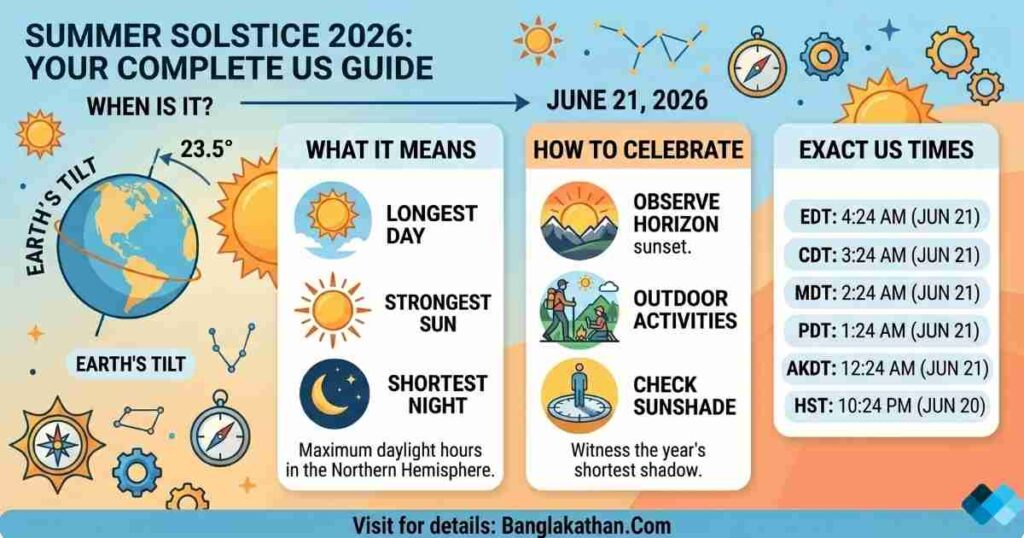
The 2026 summer solstice (the first official day of astronomical summer) occurs exactly on Sunday, June 21, 2026, at 4:24 AM Eastern Daylight Time (EDT).
Here is when the longest day of the year begins across the major US time zones:
- Eastern Time (EDT): 4:24 AM (Sunday, June 21)
- Central Time (CDT): 3:24 AM (Sunday, June 21)
- Mountain Time (MDT): 2:24 AM (Sunday, June 21)
- Pacific Time (PDT): 1:24 AM (Sunday, June 21)
- Alaska Time (AKDT): 12:24 AM (Sunday, June 21)
- Hawaii Time (HST): 10:24 PM (Saturday, June 20)
Detailed Explanation
For those of us in the US, the summer solstice marks the astronomical beginning of summer. But what exactly is happening up there in the sky?
It’s all about Earth’s tilt. Our planet doesn’t sit straight up and down in its orbit; it leans on an axis of about 23.5 degrees. During the June solstice, the North Pole reaches its maximum tilt toward the sun. This means the sun climbs to its highest, northernmost point in our sky, positioned directly over the Tropic of Cancer.
Because of this direct angle, the Northern Hemisphere gets bathed in the maximum possible amount of sunlight. This astronomical event results in the “longest day” (meaning the most daylight hours) and the “shortest night” of the entire year for the United States.
How to Experience the 2026 Solstice
Want to make the most of the longest day of the year? Here is a simple step-by-step guide to celebrating the 2026 summer solstice:
- Check Your Local Sunrise/Sunset Time: Since the solstice hits early Sunday morning for the mainland US, plan to wake up early on June 21 to catch the earliest morning light, or stay out late on Saturday night.
- Look for the “No Shadow” Effect: Step outside at solar noon (usually around 1:00 PM during Daylight Saving Time). Since the sun is at its highest peak, your shadow will be the shortest it gets all year!
- Plan an Outdoor Event: With hours of extra evening daylight, this is the perfect Sunday for an extended family picnic, a late hike, or an evening beach trip.
- Observe the Horizon: Take note of where the sun sets. On the summer solstice, the sun sets as far north of due west as it ever gets.
Key Points to Remember
- A Global Instant: The solstice isn’t just a whole day; it happens at the exact same fraction of a second everywhere on Earth (08:24 UTC). Only the local clock time changes.
- Longest Day, Not the Hottest: Even though the earth absorbs the most sunlight on this day, the hottest days usually come in July and August. This lag happens because Earth’s oceans and landmasses take time to heat up.
- Days Start Getting Shorter: Ironically, the first day of summer is also the turning point. From June 22 onward, the days will slowly start getting shorter until the winter solstice in December.
Comparison: Summer vs. Winter Solstice
| Feature | Summer Solstice (June) | Winter Solstice (December) |
|---|---|---|
| Date in 2026 | June 21 | December 21 |
| Earth’s Tilt | Northern Hemisphere tilted toward the sun | Northern Hemisphere tilted away from the sun |
| Daylight Hours | Maximum (Longest day) | Minimum (Shortest day) |
| Sun’s Position | Highest in the sky | Lowest in the sky |
| Southern Hemisphere | Experiences Winter | Experiences Summer |
Common Mistakes
- Mistake: “The solstice is always on June 21.”
Reality: While it falls on June 21 in 2026, it frequently occurs on June 20. The date shifts slightly because our calendar has 365 days, but it takes Earth 365.24 days to orbit the sun. Leap years help adjust this timing. - Mistake: “Earth is closest to the sun on the summer solstice.”
Reality: It’s actually the opposite! The Earth is farthest from the sun (a point called aphelion) in early July. It’s the tilt of the Earth, not the distance, that causes our warm summer. - Mistake: “The earliest sunrise happens on the solstice.”
Reality: Because Earth’s orbit is an ellipse, the earliest sunrise actually happens a few days before the solstice, and the latest sunset happens a few days after.
People Also Ask
Is the summer solstice the longest day of the year?
Yes, for the Northern Hemisphere (including the entire US), the summer solstice provides the longest period of daylight and the shortest night of the calendar year.
Does summer start on June 20 or 21 in 2026?
For the vast majority of the United States, astronomical summer starts on Sunday, June 21, 2026. However, in Hawaii, the exact moment falls late at night on Saturday, June 20.
Why does the summer solstice date change?
The date shifts because the Earth’s orbit around the sun doesn’t perfectly align with our 365-day Gregorian calendar. Leap years reset the math, causing the solstice to bounce between June 20 and June 21.
How many hours of daylight do we get on the summer solstice?
It depends entirely on your latitude! In New York City, you get about 15 hours of daylight. In Anchorage, Alaska, you get nearly 19.5 hours, while Miami, Florida sees about 13.5 hours.
FAQ
Q: What is meteorological summer vs. astronomical summer?
A: Astronomical summer is based on Earth’s tilt relative to the sun (starting June 21, 2026). Meteorological summer is based on the annual temperature cycle and calendar months, beginning exactly on June 1 every year.
Q: Can you see the exact moment the solstice happens?
A: You can’t see the exact minute occur in the sky, but you can observe its effects by noticing the extreme northern position of the sun at sunrise and sunset, and how high it sits in the sky at solar noon.
Q: Does the Southern Hemisphere experience the summer solstice in June?
A: No. Because the Southern Hemisphere is tilted away from the sun in June, this exact same moment acts as their winter solstice (the shortest day of the year).
Q: Will the moon affect the 2026 summer solstice?
A: The moon’s gravitational pull slightly affects Earth’s orbit and rotation over long periods, but it has no noticeable impact on your daily experience of the 2026 solstice.
💡 Pro Tip: Bookmark this page or share it with your family and friends so you can easily check your local US times when June 2026 rolls around!
Reference / Source List:
- US Naval Observatory (USNO) – Astronomical Applications Department
- Time and Date (timeanddate.com) – Global solstice tracking tools
- The Farmers’ Almanac – Historical seasonal data and daylight hours