
What is Oura Ring 5 and what does it actually do?
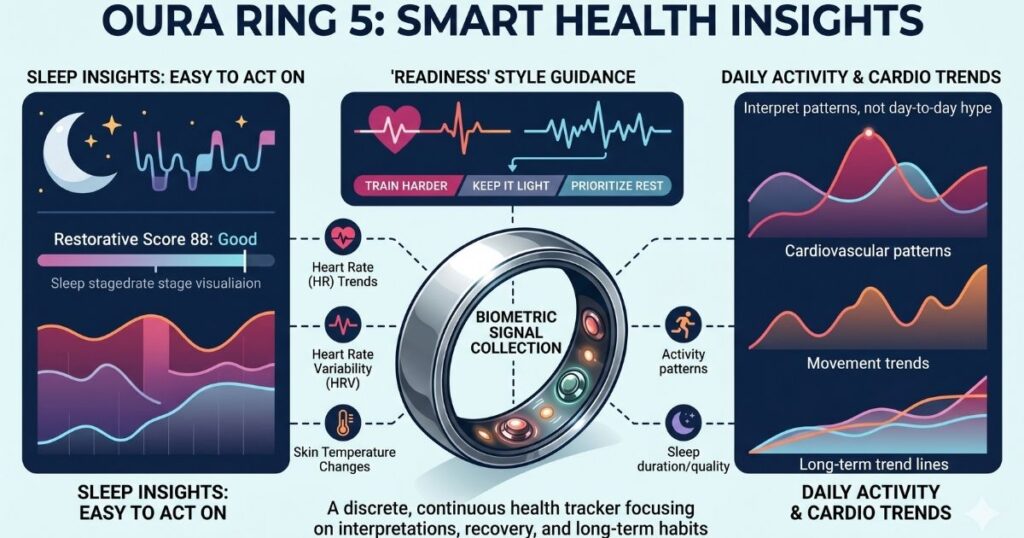
Oura Ring 5 is a wearable ring designed to collect biometric signals and turn them into sleep and recovery insights, plus daily activity and cardiovascular trend tracking.
Instead of “just numbers,” Oura focuses on interpreting patterns over time—so you can answer questions like:
- Why did I sleep poorly last night?
- How recovered am I today?
- Are my heart-rate patterns trending in a healthier direction?
- What daily habits are affecting my sleep?
The main benefits people actually care about
Sleep insights that are easy to act on
Oura’s sleep features generally emphasize:
- Sleep timing consistency
- Sleep stages/trends (interpretations based on sensor signals)
- Restorative score style guidance (recovery focus)
- Signals that often correlate with sleep quality (like HR/HRV/temperature patterns)
“Readiness” style daily guidance (recovery-first)
Most users value Oura for the readiness/recovery framing, which helps you decide whether to:
- train harder,
- keep it light,
- prioritize rest,
- or adjust routines (stress, sleep schedule, late-night habits).
Long-term trends over day-to-day hype
The biggest win of Oura Ring 5 is that it’s meant to be worn consistently so insights improve as your baseline becomes clearer.
What Oura Ring 5 measures
Oura Ring devices typically use sensors to estimate or track:
- Heart rate (HR) and HR trends
- Heart rate variability (HRV) (commonly used as a recovery/stress signal)
- Skin temperature changes (often used as a wellness/recovery indicator)
- Activity (movement trends and general activity patterns)
- Sleep (sleep duration and quality signals)
Tip: Look at Oura’s own documentation for the exact list of tracked metrics and how “sleep stages” are presented for your region.
Who should consider Oura Ring 5?
Oura Ring 5 is especially useful if you’re:
- prioritizing sleep improvement (most common reason)
- active and want recovery guidance before workouts
- interested in stress and recovery signals
- uncomfortable wearing a watch all day/night
- looking for a discreet, “wear it always” health tracker
It may be less ideal if you want:
- advanced medical-grade diagnosis
- real-time alerts like a smartwatch (Oura is more “insights” than “alarm”)
- purely competitive sports training analytics
Oura Ring 5 vs. competitors
Here’s a simple way to choose:
- Choose Oura Ring 5 if you want sleep + readiness insights with a lighter wear feel.
- Choose a fitness watch if you want built-in GPS, advanced workout displays, or more sport-specific metrics.
- Choose medical devices (doctor-guided) if you need clinically validated measurements for a condition.
How accurate is Oura Ring 5 for sleep?
What most people should know (honest accuracy expectations)
Wearables like Oura estimate sleep stages and recovery signals from biosensor patterns. That means:
- It’s usually excellent for trends (this week vs last week).
- It may vary for exact stage labeling compared with clinical methods.
- Consistency in wearing it correctly matters a lot.
Best practice for accuracy:
- Wear it snug (not too tight, not loose)
- Place it on a consistent finger (avoid switching daily)
- Charge and keep firmware/app updated
- Compare outcomes as patterns, not as single-night “pass/fail”
How to get better results with Oura Ring 5
Step 1: Get comfortable wearing it
- Wear it during the day so it adapts to your baseline.
- Aim for consistent daily use, including nights.
Step 2: Don’t panic over one bad night
Use a 7–14 day view. One night can be influenced by:
- alcohol
- late meals
- travel
- stress spikes
- illness onset
Step 3: Match insights to your real life
When Oura flags something (like reduced readiness), ask:
- Did I sleep less?
- Did I have late caffeine?
- Was I more stressed than usual?
- Did I train hard yesterday?
Step 4: Use your “trend” to change one habit
Pick one small lever:
- earlier bedtime window
- consistent wake time
- reduce late-night screen exposure
- schedule workouts earlier
- improve dinner timing (not too late)
Step 5: Re-check after a week
If sleep improves, keep the habit. If not, try a second adjustment.
Battery life and daily charging—what to expect
Battery performance depends on device mode and usage (and can change with software updates). The best way to verify exact battery days for Oura Ring 5 is to check:
- Oura’s official product specs page
- the app/device settings section for charge estimates
Practical user guidance:
- If you want “set it and forget it,” charge overnight or during a predictable routine.
- Use the charger reliably to avoid connection issues.
Why this matters for accuracy
A ring’s fit affects sensor contact, which affects sleep and HR/HRV signal quality.
General sizing guidance:
- Measure your ring size using Oura’s sizing tools if available.
- If the ring feels too loose at night, it can reduce signal stability.
- If it feels tight enough to leave marks, loosen as needed.
(Again, confirm exact fit guidance from Oura’s official docs for Oura Ring 5.)
Is Oura Ring 5 worth it?
It’s worth considering if:
- You want sleep and recovery guidance that helps you act.
- You like trend-based insights more than “instant” sports stats.
- You’re willing to wear it consistently for at least 2 weeks to establish a baseline.
It may not be worth it if:
- you want medical-grade diagnosis
- you hate charging or daily routines
- you expect pinpoint accuracy for every single sleep stage
What you should know as a US customer
Smart health wearables collect sensitive data. To make a decision confidently:
- review Oura’s privacy policy and data handling statements
- understand what data is stored on-device vs in the app/cloud
- check sharing settings (if any)
- consider using account security best practices (strong password + 2FA if offered)
(Use Oura’s official privacy resources to verify current terms.)
People Also Ask
Q1: Does Oura Ring 5 track heart rate continuously?
Answer: Oura Ring devices are designed to measure cardiovascular signals throughout the day and night to produce metrics like heart-rate trends and recovery-related values. For exact “continuous” language, verify in Oura’s official Oura Ring 5 product documentation.
Q2: Can Oura Ring 5 detect illness or when I’m getting sick?
Answer: Oura often provides wellness trend insights that may reflect changes in recovery, temperature-related signals, and resting patterns. However, it’s not a medical diagnostic device—use it as an early “signal,” and consult a clinician for symptoms.
Q3: How long does it take to see results?
Answer: Many users notice changes in sleep and readiness interpretation within 1–2 weeks, but the most meaningful baseline comes after consistent wear for several weeks. Consistency matters more than perfection.
Q4: Is Oura Ring 5 better than Oura Ring 4?
Answer: Oura’s newer ring models may bring improvements in sensors, comfort, and software experiences. The best way to confirm “better” for you is to compare:
- the exact features listed for each generation on Oura’s official site
- user experience in your priority area (sleep accuracy, comfort, battery, insights)
Q5: Do I need a subscription for Oura Ring 5?
Answer: Oura’s app features and analytics may involve account features or subscription terms depending on the current program. Check Oura’s official “membership” or pricing page for the latest requirement details.
Q6: What finger should I wear Oura Ring 5 on?
Answer: Oura typically recommends consistent placement and provides guidance on supported fingers. For best tracking, keep it on the same finger unless Oura instructs otherwise.
Q7: Can Oura Ring 5 help with stress management?
Answer: Oura can reflect stress/recovery patterns through HRV and related signals, and it can show you how habits affect recovery. It’s supportive—not a replacement for mental health care.
Q8: Is Oura Ring 5 waterproof?
Answer: Many rings in this category are water-resistant for daily activities. For “shower/swimming” confidence, verify the official water-resistance rating and any usage limitations from Oura’s product documentation.
Q9: Will Oura Ring 5 replace my smartwatch?
Answer: It depends on what you need. If you want sleep/recovery insights and minimal wear complexity, Oura may replace some use cases. If you need GPS, advanced workouts, or messaging/alerts, a smartwatch may still be better.
Q10: Who should avoid using consumer wearables for medical decisions?
Answer: People who require clinical monitoring for serious conditions should rely on healthcare professionals. Wearables can support awareness but should not replace diagnosis or treatment.
Update policy: This article is updated to reflect major changes in Oura’s official documentation or widely accepted wearable guidance. For any time-sensitive specs (battery days, subscription terms, sensor details), verify using the “Sources to confirm” list below.
Sources
To ensure you have the most up-to-date and verified Oura Ring 5 details, check:
- Oura official product page/specs (Oura Ring 5 overview and key specs)
- Oura support articles (setup, sizing, battery guidance, water resistance, data/privacy)
- Oura privacy policy & terms (data handling, account/membership terms)
- For general wearable context (sleep staging limitations and HRV interpretations):
- peer-reviewed reviews in sleep monitoring and HRV interpretation (via PubMed/major journals)
