
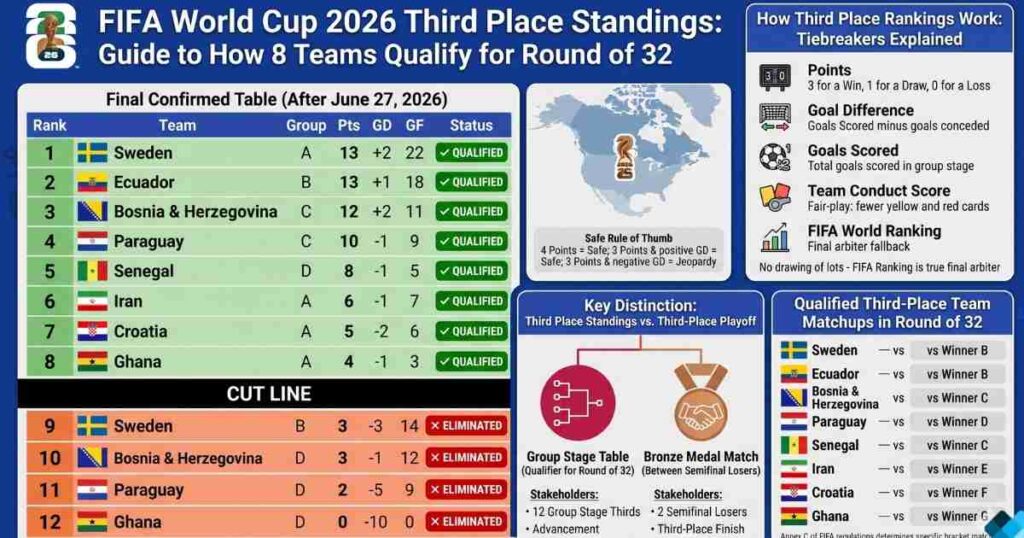
The 2026 FIFA World Cup third place standings determine which eight of the twelve group-stage third-place finishers advance to the Round of 32 — a rule that is brand new to the World Cup this year. At the 2026 tournament in the USA, Canada, and Mexico, any team finishing third in its group is ranked in a single cross-group table, and the top eight advance. As of June 27–28, 2026, the final standings confirm: Sweden, Ecuador, Bosnia and Herzegovina, Paraguay, Senegal, Iran, Croatia, and Ghana are the eight teams that have qualified.
What Are the FIFA World Cup Third Place Standings in 2026?
For the first time in World Cup history, finishing third in your group does not automatically send you home.
With the field expanded to 48 teams split across 12 groups of four, FIFA needed a creative solution to fill a 32-team knockout bracket. The answer: take the eight best third-place finishers from across all twelve groups and give them a seat in the Round of 32.
That means 12 teams fall into third in their groups, and then all 12 are ranked against each other in one unified table. The top eight advance. The bottom four are eliminated. This cross-group comparison is what “third place standings” refers to at the 2026 World Cup — and with a single goal potentially separating qualifiers from the eliminated, it became one of the most gripping storylines of the entire group stage.
Bookmark this page now — the Round of 32 begins June 28, and knowing who the third-place teams are tells you the full bracket picture.
2026 World Cup Third Place Standings: Final Confirmed Table (After June 27)
The group stage officially ended on June 27, 2026. Here is the final third-place standings table, confirming all eight qualified teams:
| Rank | Team | Group | Pts | GD | GF | Status |
|---|---|---|---|---|---|---|
| 1 | Sweden | F | 4 | 0 | 6 | ✅ QUALIFIED |
| 2 | Ecuador | E | 4 | 0 | 2 | ✅ QUALIFIED |
| 3 | Bosnia & Herzegovina | B | 4 | -1 | 2 | ✅ QUALIFIED |
| 4 | Paraguay | D | 4 | -2 | 0 | ✅ QUALIFIED |
| 5 | Senegal | I | 3 | +2 | 5 | ✅ QUALIFIED |
| 6 | Iran | G | 3 | 0 | 3 | ✅ QUALIFIED |
| 7 | Croatia | L | 3 | -1 | 3 | ✅ QUALIFIED |
| 8 | Ghana | L | 3 | -1 | 2 | ✅ QUALIFIED |
| — | CUT LINE | — | — | — | — | — |
| 9 | South Korea | A | 3 | -1 | 3 | ❌ ELIMINATED |
| 10 | Algeria | J | 3 | -2 | 2 | ❌ ELIMINATED |
| 11 | Scotland | C | 3 | -3 | 2 | ❌ ELIMINATED |
| 12 | DR Congo | K | 1 | -1 | 1 | ❌ ELIMINATED |
Sources: FOX Sports, NBC Sports, Yahoo Sports, ESPN — updated June 27–28, 2026
How the Third Place Rankings Work: Rules & Tiebreakers Explained
Why You Can’t Use Head-to-Head Results
Unlike within a single group — where head-to-head results are the very first tiebreaker — the cross-group third-place table cannot use head-to-head, because the twelve third-place teams never played each other. FIFA therefore ranks them purely by their three group-stage results using the following criteria, in order:
- Points — three for a win, one for a draw, zero for a loss
- Goal difference — goals scored minus goals conceded across all three group games
- Goals scored — total goals scored in all three group games
- Team conduct score — a fair-play tiebreaker; fewer yellow and red cards equals a higher score and a better ranking
- FIFA World Ranking — the ultimate fallback, using the official June 11, 2026 ranking list if everything else is equal
FIFA also confirmed for 2026 that there will be no drawing of lots — the FIFA World Ranking is the true final arbiter. This matters because it means discipline can directly affect whether a team advances.
The “Four Points Is Safe” Rule of Thumb
Across the group stage, it became clear that four points in third place was effectively a guarantee of advancement. Three points with a positive or zero goal difference was usually enough. Three points with a negative goal difference created genuine jeopardy — as South Korea and Algeria discovered. Two points was not enough; Uruguay and others were eliminated with that total.
Pro tip for understanding the standings: Because teams come from different groups and play different opponents, a team with two losses and one win (3 points) can rank higher than a team with three draws (also 3 points) purely on goal difference or goals scored. The absolute number of goals conceded matters as much as the number won — so even a 1-0 loss can be more damaging than a 3-2 one in some scenarios.
How Each of the 8 Qualified Third-Place Teams Got There
Sweden (Group F — 4 points, GD: 0)
Sweden topped the third-place standings throughout most of the group stage. They entered their final game against Japan with four points already secured after their 5-1 opening win over Tunisia and a 1-1 draw with the Netherlands. The final 1-1 result against Japan was enough to confirm qualification. Sweden’s balance of points and solid goal difference made them the most comfortable qualifier of all third-place teams.
Ecuador (Group E — 4 points, GD: 0)
Ecuador delivered the biggest shock of Group E, defeating four-time world champions Germany 2-1 in their final group game — a result that went viral globally. They had been held scoreless by Ivory Coast and Curaçao in earlier matches, but the Germany result sent them through and made them the first third-place team to mathematically clinch a Round of 32 spot.
Bosnia and Herzegovina (Group B — 4 points, GD: -1)
Bosnia qualified third behind Switzerland and Canada, collecting four points. Their passage was confirmed relatively early, and they earned the reward of a Round of 32 clash with the USA on July 1 in Santa Clara, California — the most high-profile potential matchup among the eight qualifying thirds.
Paraguay (Group D — 4 points, GD: -2)
Paraguay’s journey was nerviest among the four-point qualifiers. Their 0-0 draw against Australia gave them four points but a goal difference of -2, leaving them technically at risk until enough other groups finished. Once five potential overtakers all fell short, Paraguay’s spot was confirmed.
Senegal (Group I — 3 points, GD: +2)
Senegal announced their qualification in emphatic fashion with a 5-0 demolition of Iraq in their final group match. That result jumped them to fifth in the table on goal difference and made it mathematically impossible for them to be displaced from the top eight. Their positive +2 goal difference comfortably separated them from the other three-point sides.
Iran (Group G — 3 points, GD: 0)
Iran’s path through was one of the most dramatic of the tournament. They drew all three group games (2-2 with New Zealand, 0-0 with Belgium, 1-1 with Egypt) and had a last-minute “winner” against Egypt controversially ruled out for offside in stoppage time. They squeezed in sixth on zero goal difference, above South Korea and Algeria, who also had three points but worse goal differences.
Croatia (Group L — 3 points, GD: -1)
Croatia’s inclusion came at Scotland’s direct expense. By defeating Ghana 2-1 in their final group game, Croatia moved to three points and simultaneously knocked Scotland — who had finished with three points and -3 GD — out of the qualified eight. Croatia face the runner-up of Group K in the Round of 32.
Ghana (Group L — 3 points, GD: -1)
Despite losing to Croatia in the final game, Ghana had enough points from their earlier results (a 1-0 win over Panama and a draw with England) to stay inside the top eight. Their -1 goal difference matched Croatia’s exactly, but other tiebreakers separated them to finish eighth — just edging South Korea, who also sat on three points and -1 goal difference from Group A.
Important Distinctions
“Third Place Standings” vs. “The Third-Place Playoff”
These are two completely different things, and confusion between them is widespread.
| Best Third-Place Standings | Third-Place Playoff | |
|---|---|---|
| What it is | Cross-group table to find 8 Round of 32 qualifiers | Bronze medal match between losing semifinalists |
| When it happens | Group stage | July 18, 2026 |
| Teams involved | 12 group-stage third-place teams | 2 losing semifinalists |
| Stakes | Knockout-round advancement | Tournament’s third-place finish |
When people search for “FIFA World Cup third place standings,” they almost always mean the group-stage qualifier table — not the bronze-medal game.
Does Finishing Third Mean a Hard Path?
Yes — significantly so. FIFA’s pre-set bracket mapping (Annex C of the official regulations) always pairs each qualifying third-place team against a group winner, not a runner-up. So every team that advanced via the third-place route faces one of the tournament favorites in the Round of 32. There are no “easy” draws for third-place qualifiers.
Can Three Teams From the Same Group Advance?
Technically yes under the 48-team format. If the top two from a group advance automatically and that group’s third-place team also ranks among the best eight across the tournament, then three teams from one group are all in the knockout stage. This didn’t happen in 2026, but the format allows it.
People Also Ask
Q: How many third-place teams qualify for the 2026 World Cup knockout stage? Eight of the twelve third-place teams advance to the Round of 32. The other four are eliminated.
Q: Who are the eight third-place qualifiers at the 2026 World Cup? Sweden, Ecuador, Bosnia and Herzegovina, Paraguay, Senegal, Iran, Croatia, and Ghana all advanced as the eight best third-place teams after the group stage ended on June 27, 2026.
Q: How is the best third place decided at the 2026 World Cup? All 12 third-place teams are ranked by points, then goal difference, then goals scored, then a team conduct (fair play) score based on cards, then FIFA World Ranking. The top eight advance.
Q: What happens to third-place teams in the 2026 World Cup bracket? They are placed against group winners in the Round of 32. The specific matchup depends on which group(s) produced the qualifying third-place teams, using a pre-set 495-combination bracket system published by FIFA in advance.
Q: Is there a third-place game at the 2026 World Cup? Yes, but it is entirely separate from the group-stage third-place standings. The third-place playoff (bronze medal match) is scheduled for July 18, 2026, between the two semifinal losers.
Q: What is the minimum points needed to qualify as a best third-place team? There is no fixed minimum, but in 2026, four points guaranteed qualification, three points with a positive goal difference was very likely safe, and two points was not enough for any team to advance.
Q: Why did Scotland get eliminated despite having three points? Scotland had three points and a goal difference of -3, which was worse than the other three-point teams. Their heavy goal difference deficit meant they were ranked tenth once all groups were settled, outside the top eight.
Q: Do third-place teams get seeded or draw easier opponents in the knockouts? No. All eight qualifying thirds are drawn against group winners — the highest-seeded teams in the bracket — as determined by FIFA’s pre-set bracket assignment rules.
Q: What is the FIFA World Cup third place standings? It is a combined ranking table of all twelve third-place teams from the group stage, used to determine which eight of them advance to the Round of 32. Teams are ranked by points, goal difference, goals scored, fair-play score, and FIFA ranking.
Q: Has this format existed in previous World Cups? No. The best-eight-third-place rule is exclusive to the 2026 World Cup, introduced because FIFA expanded the tournament from 32 to 48 teams for the first time. At all previous 32-team World Cups, finishing third in a group meant automatic elimination.
Q: When was the 2026 third-place standings finalized? The final standings were locked in after June 27, 2026, when all 12 groups completed their third and final round of group matches.
Q: Who was the first team to clinch a third-place spot in 2026? Ecuador were the first third-place team to mathematically secure their Round of 32 spot, following their stunning 2-1 win over Germany on June 25, 2026.
Q: Can a third-place team win the 2026 World Cup? Absolutely. Once the Round of 32 begins, every team is on equal footing. A third-place qualifier must win five consecutive knockout matches to lift the trophy — the same number as anyone else who enters from the Round of 32. Precedent exists in other tournaments: Portugal won Euro 2016 having entered the knockout stage as a third-place team.
Q: What tiebreaker comes after goal difference in the third-place standings? Goals scored comes next. If two teams are tied on both points and goal difference, the team that scored more goals in total across all three group games ranks higher.
Q: Does card discipline really matter for the standings? Yes, and it played a role in 2026. The team conduct score — based on yellow and red cards accumulated — was a tiebreaker between several three-point sides. Fewer cards means a higher conduct score and a better ranking if points and goal difference are equal.
Q: How do the Round of 32 matchups work for third-place teams? FIFA published 495 possible bracket combinations in advance. The specific matchups are determined by which groups the qualifying third-place teams came from. Once all groups finish, the correct combination is applied, pairing each qualifying third against a group winner.
Q: What is the third-place play-off match at the 2026 World Cup? Separate from the group-stage standings, the third-place play-off is a bronze-medal match between the two losing semifinalists, scheduled for July 18, 2026 — one day before the final at MetLife Stadium in New Jersey.
Q: Why don’t head-to-head results count in the third-place standings? Because the 12 third-place teams never played each other during the group stage. They were in different groups, so there are no head-to-head results to compare. FIFA therefore uses each team’s full group-stage record as the measure.
The 2026 FIFA World Cup third place standings are a cross-group ranking table that determines which 8 of the 12 group-stage third-place finishers advance to the Round of 32 — a brand-new feature of the expanded 48-team World Cup format.
Teams are ranked by: (1) points, (2) goal difference, (3) goals scored, (4) team conduct/fair-play score, (5) FIFA World Ranking.
The eight qualified teams after the group stage (ending June 27, 2026) are: Sweden (Group F, 4 pts), Ecuador (Group E, 4 pts), Bosnia and Herzegovina (Group B, 4 pts), Paraguay (Group D, 4 pts), Senegal (Group I, 3 pts), Iran (Group G, 3 pts), Croatia (Group L, 3 pts), and Ghana (Group L, 3 pts).
All eight are drawn against group winners in the Round of 32 (June 28 – July 3, 2026). The third-place standings should not be confused with the third-place play-off bronze medal match, which is a separate event scheduled for July 18, 2026.
Last Updated: June 28, 2026
Reference / Source List:
- FIFA.com — Official 2026 World Cup standings: https://www.fifa.com/en/tournaments/mens/worldcup/canadamexicousa2026/standings
- FOX Sports — “2026 World Cup Third-Place Standings: Who’s In, Who’s On The Bubble” (updated June 27, 2026)
- ESPN — “2026 World Cup: How teams can advance to the knockout rounds” (updated June 27, 2026)
- Yahoo Sports / Sporting News — “World Cup third place standings: Updated table” (June 27, 2026)
- NBC Sports — “Which World Cup third-place teams will advance to knockout stage?” (June 27, 2026)
- Euronews — “2026 FIFA World Cup: Which third-place teams will reach the knockout stage?” (June 27, 2026)
- FIFA Official Regulations, Article 13 — Ranking of third-placed teams
- FIFA Official Regulations, Annex C — Round of 32 bracket mapping
