
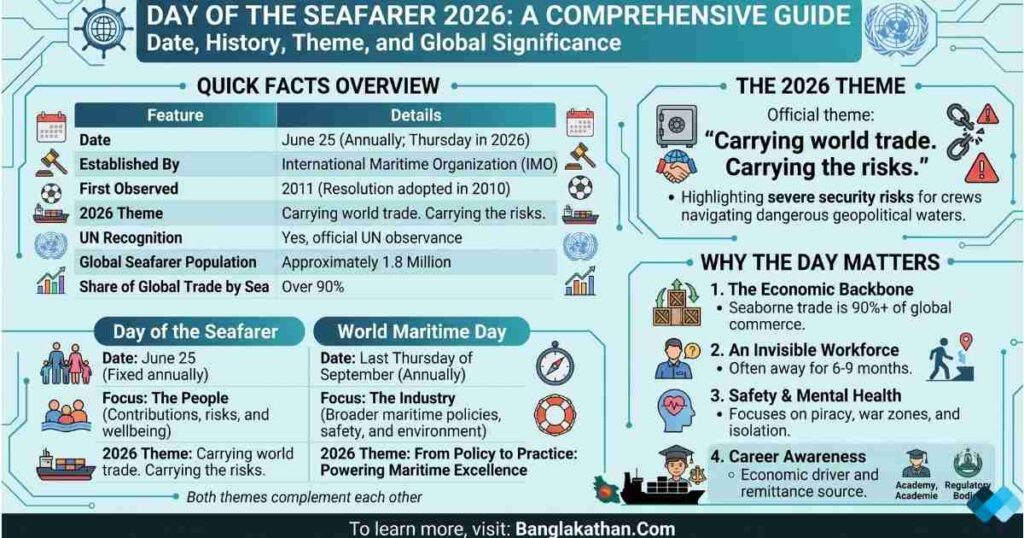
Every year on 25 June, the world observes the Day of the Seafarer. In 2026, that date falls on a Thursday. Established by the International Maritime Organization (IMO), the day exists to recognize the roughly 1.9 million men and women who keep more than 90% of global trade moving across the oceans — often for months at a time, far from home.
The Day of the Seafarer is observed every year on 25 June. It was established by a resolution adopted at the 2010 IMO Diplomatic Conference in Manila — the same conference that adopted the revised STCW Convention on seafarer training and certification. The day was first observed in 2011, and the United Nations recognizes it as an official international observance. Each year, the IMO sets a new theme; for 2026, the theme is “Carrying world trade. Carrying the risks,” highlighting the hidden dangers seafarers face while keeping global supply chains running.
Day of the Seafarer 2026
| Item | Detail |
|---|---|
| Date | 25 June every year (Thursday in 2026) |
| Established by | International Maritime Organization (IMO) |
| Year established | 2010 (first observed 2011) |
| 2026 theme | “Carrying world trade. Carrying the risks” |
| UN recognition | Yes |
| Global seafarer workforce | Approx. 1.9 million |
| Share of world trade moved by sea | Over 90% |
| Top seafarer-supplying countries | Philippines, Russia, Indonesia, China, India |
The History Behind the Day of the Seafarer
The idea for a dedicated day to honor seafarers came out of the 2010 Diplomatic Conference in Manila, where governments gathered to revise the STCW Convention — the international rulebook covering how seafarers are trained, certified, and rostered for watchkeeping duties. The resolution adopted there called on governments, shipping companies, shipowners, and maritime organizations to mark the day meaningfully every year.
The first official observance took place in 2011. Since then, the IMO has used social media as the main channel for spreading awareness, encouraging the public to thank seafarers directly online. Past themes have tackled bullying and harassment at sea, fair treatment of crews, mental health, and the future of the maritime workforce — each one chosen to spotlight a pressing issue for the industry that year.
Day of the Seafarer vs. World Maritime Day
These two observances are easy to confuse, but they’re not the same thing:
| Aspect | Day of the Seafarer | World Maritime Day |
|---|---|---|
| Date | Fixed: 25 June every year | Last Thursday of September |
| Focus | Individual seafarers — their contribution and risk | The shipping industry and maritime policy as a whole |
| 2026 theme | Carrying world trade. Carrying the risks | From Policy to Practice: Powering Maritime Excellence |
| Theme duration | New theme each year | 2026–2027 theme runs for two consecutive years |
The two themes are designed to complement each other: one focuses on turning maritime policy into real-world practice, the other reminds the world that seafarers are the ones who carry that policy out on the water.
The 2026 Theme: “Carrying World Trade. Carrying the Risks”
This year’s campaign puts a spotlight on the hardship and danger of working in high-risk and conflict-affected waters — regions like the Red Sea and the Strait of Hormuz, where commercial vessels have faced real security threats in recent years. The core message: seafarers are responsible for moving the goods that keep the global economy running, but the risk and personal cost behind that work often goes unseen.
Key elements of the campaign:
- Drawing attention to the safety risks faced by crews navigating politically unstable or conflict-affected sea routes
- Reminding shipping companies of their responsibility for crew mental health and wellbeing
- Encouraging the public, companies, and seafarers themselves to share real stories using the hashtag #DayoftheSeafarer
Shipping companies and crewing agencies worldwide are using the day to highlight their own safety protocols and welfare programs for crews operating in high-risk zones, from naval intelligence coordination to onboard mental health support.
Why the Day of the Seafarer Matters
Nearly everything in daily life — food, fuel, clothing, electronics — travels by sea at some point. An estimated 1.89 million seafarers, operating more than 74,000 merchant vessels, keep that system running.
Here’s why the day carries real weight:
- The backbone of global trade — Over 90% of world trade by volume moves by sea; without seafarers, global supply chains would grind to a halt.
- An invisible workforce — Because the work happens at sea, far from public view, the risks and sacrifices involved are easy to overlook.
- Safety and mental health awareness — Piracy, conflict zones, and long stretches of isolation are real occupational hazards that this day helps bring into public conversation.
- Career visibility — The day also raises awareness of seafaring as a career path, which matters for countries where maritime work is a major source of employment and remittance income.
Who Are the World’s Seafarers
According to the International Chamber of Shipping (ICS) and BIMCO, the global merchant fleet is crewed by close to 1.89 million seafarers — about 857,500 officers and just over 1 million ratings — sailing on more than 50,000 internationally trading merchant ships registered across over 150 nations. A new joint BIMCO/ICS Seafarer Workforce Report is currently being finalized for release later in 2026, which will update these figures.
The largest supplying countries for officers and ratings are the Philippines, the Russian Federation, Indonesia, China, and India. Other countries with significant and growing maritime workforces include Ukraine, Bangladesh, Myanmar, and several Eastern European and South Asian nations — reflecting how seafaring careers offer a path to skilled, internationally paid work even where land-based opportunities are limited.
How the Day of the Seafarer Is Observed Around the World
- Social media campaigns — Organizations, companies, and individuals post messages, photos, and videos under #DayoftheSeafarer to thank seafarers directly.
- Company recognition events — Shipping companies and cruise lines hold appreciation events and highlight crew welfare initiatives.
- Port city events — Maritime unions, welfare charities, and port authorities organize talks, ceremonies, and outreach programs.
- Maritime academy activities — Training institutions use the day to raise awareness of seafaring careers among students and cadets.
- Charity and welfare outreach — Maritime welfare organizations highlight chaplaincy, port welfare services, and crisis support available to seafarers and their families.
Common Misconceptions
- Misconception: The Day of the Seafarer and World Maritime Day are the same thing. Reality: They’re two distinct observances with different dates, themes, and areas of focus, as shown in the comparison table above.
- Misconception: The day is about naval or military sailors. Reality: It specifically honors civilian seafarers working on commercial merchant ships — the people moving cargo, not naval forces.
- Misconception: Seafaring is low-skilled manual labor. Reality: The profession spans a wide range of technical roles, from deck and engineering officers to ship captains, many requiring years of formal maritime education and internationally recognized certification under the STCW Convention.
People Also Ask
Who established the Day of the Seafarer? The International Maritime Organization (IMO) established the day through a resolution adopted at its 2010 Diplomatic Conference in Manila.
When was the Day of the Seafarer first observed? It was first observed on 25 June 2011.
What is the 2026 Day of the Seafarer theme? The 2026 theme is “Carrying world trade. Carrying the risks,” focused on the dangers seafarers face in high-risk and conflict-affected waters.
How many seafarers are there in the world? Industry estimates from the ICS and BIMCO put the global seafarer workforce at around 1.89 million people.
Which countries supply the most seafarers? The Philippines, Russia, Indonesia, China, and India are currently the largest suppliers of officers and ratings to the world’s merchant fleet.
Is the Day of the Seafarer a public holiday? No. It’s an international observance recognized by the UN and promoted by the IMO, but it is not a public holiday in most countries.
What’s the difference between the Day of the Seafarer and a country’s own National Maritime Day? The Day of the Seafarer is a single, internationally coordinated observance led by the IMO on 25 June. Many countries also have their own national maritime day (such as the United States’ National Maritime Day) on a different date, usually focused on that country’s own merchant marine history and industry.
What qualifications does someone need to become a seafarer? Requirements vary by country and role, but officer training typically requires completing a recognized maritime academy program and earning STCW-compliant certification in either the nautical (deck) or engineering track. Ratings generally require shorter vocational training and certification.
What are the biggest challenges seafarers face? Long periods away from family, mental health strain from isolation, demanding shift patterns, and — as this year’s theme highlights — heightened safety risks in conflict-affected or high-piracy waters.
How can the general public take part in the Day of the Seafarer? By sharing messages of thanks using #DayoftheSeafarer, sharing real stories from seafarers they know, or supporting maritime welfare charities that provide support services to crews and their families.
Is seafaring a growing career field? Industry reports have previously warned of a potential shortage of certified officers as global trade volumes grow, which means demand for trained seafarers — particularly officers — is expected to remain strong in the coming years.
Why does the IMO change the theme every year? Each year’s theme is chosen to spotlight a specific issue affecting the maritime workforce at that moment — past themes have covered harassment-free workplaces, fair treatment, and mental health, reflecting current priorities in the industry.
Key Takeaways
- The Day of the Seafarer is observed every year on 25 June; in 2026, that’s a Thursday.
- It was established by the IMO in 2010 and first observed in 2011.
- The 2026 theme, “Carrying world trade. Carrying the risks,” centers on the dangers seafarers face in high-risk and conflict-affected waters.
- Around 1.89 million seafarers worldwide move more than 90% of global trade by volume.
- The Philippines, Russia, Indonesia, China, and India are the largest sources of the world’s seafarers.
- It is distinct from World Maritime Day and is not a public holiday in most countries.
Reference / Source List:
- International Maritime Organization (IMO) — Day of the Seafarer official page
- International Maritime Organization (IMO) — World Maritime Day theme announcement
- International Chamber of Shipping (ICS) — Shipping and World Trade: Global Supply and Demand for Seafarers
- BIMCO — Seafarer Workforce Report and seafarer-focused initiatives
