
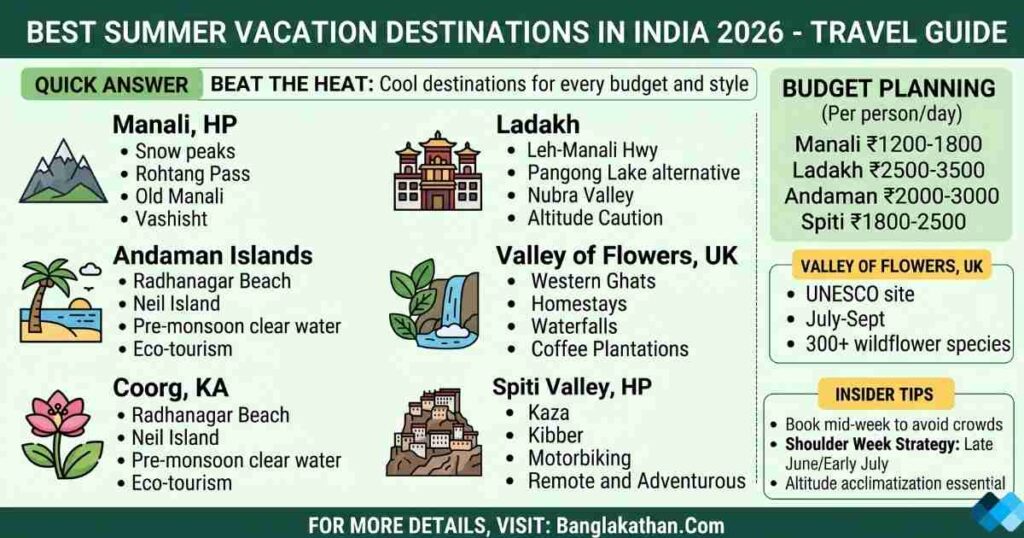
The best summer vacation destinations in India in 2026 include Manali, Shimla, Ooty, Coorg, Andaman Islands, Ladakh, and Spiti Valley. These locations offer relief from summer heat, outstanding natural beauty, and diverse experiences — from Himalayan treks to beach getaways — for every budget and travel style.
Summer in India can be brutal — temperatures crossing 45°C in the plains make many people desperately search for escape. But India’s geographic diversity is its greatest travel asset: while the north bakes, the hills stay cool, the coasts turn emerald, and remote valleys bloom with wildflowers.
This guide goes beyond the usual tourist brochure. You’ll find honest assessments, real crowd timings, budget breakdowns, and off-the-beaten-track picks that most travel blogs simply don’t cover.
Top Summer Vacation Destinations in India 2026 — At a Glance
Here’s a curated overview before we dive deep into each destination:
Manali, Himachal Pradesh
Snow peaks, Rohtang Pass, river rafting. Avg. temp: 10–20°C
Hill StationAndaman Islands
Turquoise water, coral reefs, jungle trekking. Avg. temp: 28°C
BeachLadakh
High-altitude desert, Pangong Lake, Buddhist monasteries. Avg. temp: 15°C
AdventureCoorg, Karnataka
Coffee estates, waterfalls, mist. Avg. temp: 18–25°C
Hill StationValley of Flowers, Uttarakhand
UNESCO site, 300+ wildflower species. Open: July–Sept
TrekkingSpiti Valley, HP
Ancient monasteries, stark lunar landscapes. Avg. temp: 12°C
SpiritualOoty, Tamil Nadu
Tea gardens, toy train, Nilgiris. Avg. temp: 15–20°C
Hill StationLakshadweep Islands
Lagoons, snorkeling, solitude. Very limited permits.
Beach1. Manali — The All-Rounder Hill Escape
Manali remains one of India’s most-visited summer destinations for good reason. Nestled at 2,050 meters in the Beas River valley, it offers snow, rivers, and adventure — all within reach of New Delhi by an overnight bus or flight to Bhuntar.
What most travel blogs miss about Manali in 2026
The Solang Valley cable car has been extended in 2025–26, offering views that rival Alpine resorts. Avoid the Mall Road crowd by staying in Old Manali or the quieter village of Naggar, just 22 km away — same views, a fraction of the traffic.
- Best time to visit: May to July (Rohtang Pass open, post-snow clearance)
- Crowd peak: June long weekends — arrive mid-week for a calmer experience
- Hidden gem: Chandrakhani Pass trek (3,660 m) — fewer crowds than Kheerganga but equally stunning
- Budget range: ₹800–₹2,500/night for accommodation; ₹3,000–₹8,000 for adventure packages
Book accommodation in Vashisht village rather than Manali town. You get natural hot springs, temple views, and instant access to treks — without the tourist-trap pricing on Mall Road.
2. Ladakh — The Crown Jewel of Indian Summer Travel
If you’ve been waiting to do Ladakh, 2026 is the year. The Leh–Manali Highway (open June–October) and the Leh–Srinagar Highway are fully accessible, and flight prices have become more competitive since multiple low-cost carriers added Leh routes.
Beyond Pangong Lake — what truly defines Ladakh
Pangong Lake is stunning, but it’s also extremely crowded. Instead, consider:
- Tso Moriri Lake — deeper blue, 40% fewer tourists, equally photogenic
- Nubra Valley via Khardung La — the double-hump Bactrian camels of Hunder are uniquely surreal
- Hemis National Park — the only realistic place in India to potentially spot a snow leopard during summer, with a professional guide
- Zanskar Valley — motorcycling season, jaw-dropping gorges, no mobile signal (a feature, not a bug)
Leh sits at 3,500 m. Spend the first 48 hours resting, staying hydrated, and avoiding alcohol. Do not rush to high-altitude lakes on Day 1. Altitude sickness is real and can be serious.
Inner Line Permit (ILP) — 2026 update
Foreign nationals require Protected Area Permits for areas like Nubra, Pangong, and Tso Moriri. Indian nationals need the Inner Line Permit, now available digitally via the Ladakh government portal. Apply at least 3 days in advance during peak season.
3. Andaman & Nicobar Islands — India’s Best-Kept Beach Secret
Unlike Goa, the Andamans in summer (April–June) offer clear water before the monsoon arrives in late June. The sea is calm, visibility for snorkeling and diving is excellent, and prices are significantly lower than during the December–January peak.
Which islands are actually worth it in 2026?
- Havelock Island (Swaraj Dweep): Radhanagar Beach, rated among Asia’s best. Take the ferry from Port Blair (2.5 hrs).
- Neil Island (Shaheed Dweep): Smaller, quieter, authentic island pace. Ideal for couples and solo travelers.
- Baratang Island: Limestone caves and a mangrove creek — rarely mentioned but deeply rewarding.
- Ross & Smith Islands: Connected by a natural sandbar. Accessible only by boat from Diglipur — truly off the beaten track.
The Andamans have strict eco-tourism rules. Do not touch corals, and only book SCUBA with certified operators. The underwater ecosystem is recovering and genuinely fragile.
4. Coorg (Kodagu) — South India’s Monsoon Prelude Gem
Coorg sits at 1,525 meters in the Western Ghats and is one of the few places in India where May–June is actually the ideal time to visit. The pre-monsoon mist, coffee plantation aromas, and waterfalls at peak flow make it extraordinary.
Beyond Abbey Falls — Coorg’s underrated experiences
- Tadiandamol Trek (1,748 m) — highest peak in Coorg, a full-day trek with panoramic views
- Dubare Elephant Camp — bathe elephants in the Cauvery River (book weekday slots)
- Coffee Estate Homestays — immersive stays where you learn the full harvest process; family-run options around Siddapura and Napoklu are excellent
- Mandalpatti — accessible by jeep only, sea of clouds viewpoint that’s dramatically undervisited
5. Valley of Flowers & Hemkund Sahib — The Spiritual-Natural Combination
The Valley of Flowers National Park (UNESCO World Heritage Site) opens in mid-July 2026 and remains accessible until September. Located in Chamoli district, Uttarakhand, it’s reached from Govindghat after a 14 km trek.
What makes this special is the combination: you can combine the Valley trek with Hemkund Sahib (one of the world’s highest Sikh shrines, at 4,329 m) in a 3–4 day itinerary from Joshimath.
- Fitness requirement: Moderate. Anyone with basic stamina can complete the trek.
- Best months: Late July to mid-August for maximum bloom diversity
- Entry fee: ₹150 for Indian nationals, ₹600 for foreign nationals (per day)
- No camping inside: Stay in Ghangaria village — limited lodges, book ahead
6. Spiti Valley — For the Seriously Adventurous
Spiti Valley in Himachal Pradesh is not for everyone — and that’s exactly why it’s on this list. At an average altitude of 4,270 meters, it’s one of the highest inhabited regions on Earth, often called the “middle land” between India and Tibet.
Practical reality of traveling Spiti in summer 2026
The road via Manali (Kunzum Pass, 4,551 m) opens around late May/early June. The Shimla–Kinnaur–Spiti route is open year-round but narrower. A 4WD vehicle is strongly advised.
- Key villages: Kaza (base), Kibber (world’s highest motorable village), Langza (fossil hunting), Dhankar (cliff monastery)
- Wildlife: Snow leopard, Tibetan wolf, Himalayan ibex — Spiti has one of the highest densities of snow leopards in India
- Mobile connectivity: BSNL only, patchy. Download offline maps before entering.
Budget Planning — Summer Vacation in India 2026
One of the most common questions is about realistic costs. Here’s a transparent breakdown:
| Destination | Budget/person/day (₹) | Mid-range/day (₹) | Best booked via |
|---|---|---|---|
| Manali | ₹1,200–1,800 | ₹3,500–6,000 | Direct hotel + MakeMyTrip |
| Ladakh | ₹2,500–3,500 | ₹6,000–12,000 | Local tour operators in Leh |
| Andaman | ₹2,000–3,000 | ₹5,000–9,000 | Ferry + guesthouse combo |
| Coorg | ₹1,500–2,500 | ₹4,000–8,000 | Homestay websites, Airbnb |
| Spiti Valley | ₹1,800–2,500 | ₹4,500–8,000 | Self-drive or Kaza operators |
Indian school holidays create intense demand from late May through mid-June. A trip starting June 20–July 5 in most hill stations will be 30–40% cheaper with significantly fewer crowds — without sacrificing weather quality.
Avoid these common mistakes
- Booking Manali during June long weekends — traffic jams on NH3 can mean 12+ hours from Chandigarh
- Underestimating Andaman ferry schedules — inter-island ferries run twice daily; missing one means losing a full day
- Not purchasing travel insurance before Ladakh or Spiti trips — weather cancellations and medical evacuations are expensive without it
- Ignoring altitude medication — Diamox (acetazolamide) should be discussed with a doctor before high-altitude trips
Sustainable travel in 2026
Over-tourism is a genuine crisis at many Indian hill stations. Practical steps that actually help:
- Stay in community homestays rather than large hotel chains — money stays local
- Use reusable water bottles with a filter — single-use plastic is a major pollution issue in mountain regions
- Hire local guides instead of outsourcing through distant aggregators
- Follow the “carry in, carry out” principle on treks — leave no trace
Frequently Asked Questions (FAQ)
Based on top search queries for summer travel in India:
Which is the coldest place in India during summer 2026?
Is it safe to travel to Ladakh in June 2026?
What are the best budget hill stations for summer vacation in India?
Which India destination is best for a family summer vacation with children?
Can I visit Andaman Islands in summer (May–June)?
Conclusion
India’s summer travel landscape in 2026 is richer than it has ever been — with better road infrastructure, more direct flights to Leh and the Northeast, growing eco-tourism options, and a wave of thoughtfully run homestays. Whether you’re chasing snow in Manali, coral in the Andamans, or monastic silence in Spiti, the key is planning early, traveling sustainably, and going beyond the predictable tourist trail. The most rewarding summer vacations in India are rarely the most crowded ones.
References
- 01Ministry of Tourism, Government of India — india.gov.in/tourism (2026 travel advisories)
- 02Ladakh Autonomous Hill Development Council — lahdc.gov.in (ILP permit requirements, 2026)
- 03Andaman & Nicobar Islands Tourism Department — andamantourism.gov.in
- 04UNESCO World Heritage Convention — Valley of Flowers National Park listing
- 05Himachal Pradesh Tourism Development Corporation — hptdc.in (Spiti & Manali road status)
- 06National Disaster Management Authority (India) — ndma.gov.in (altitude sickness guidelines)
- 07Wildlife Institute of India — wii.gov.in (snow leopard conservation, Hemis NP)
- 08Uttarakhand Tourism — uttarakhandtourism.gov.in (Valley of Flowers trek permits)